















News
Professional Charcoal Grill: Robata, Parrilla, Antikristo, or Kontosouvli Rotisserie — What Suits Your Kitchen?

Sep
Every few weeks, we receive the same question, phrased in ten different ways: “I want something charcoal-fired. What should I get?”
The answer rarely lies in the equipment itself. The exact same grill that works wonders in a souvlaki shop serving 200 portions a night won’t suit a steakhouse grilling fifteen tomahawk steaks—and vice versa.
This guide is written for professionals planning to invest in charcoal equipment who want to make their decision based on technical criteria: productivity, ventilation, fuel consumption, space, staffing, and maintenance costs. If you are looking for a list of what we can manufacture, you will find it in our comprehensive guide to custom BBQ builds.
Menu first, machine second: the three questions
Before looking at any specifications, answer three questions. These are the same ones we ask in every assessment:
- What are you grilling? A 90-gram skewer and a 3-kilogram shoulder require completely different heat management. The former needs intensity and speed; the latter needs time and distance.
- How many portions are served during peak hours? The critical metric isn’t the daily total—it’s the number of portions prepared during the two-hour rush. Equipment that handles the average volume but buckles under peak demand comes at a cost during every service.
- How many hands are at the grill? Some techniques require a dedicated, experienced griller. Others rely on automation and supervision.
With these three factors in mind, the choice becomes almost obvious.
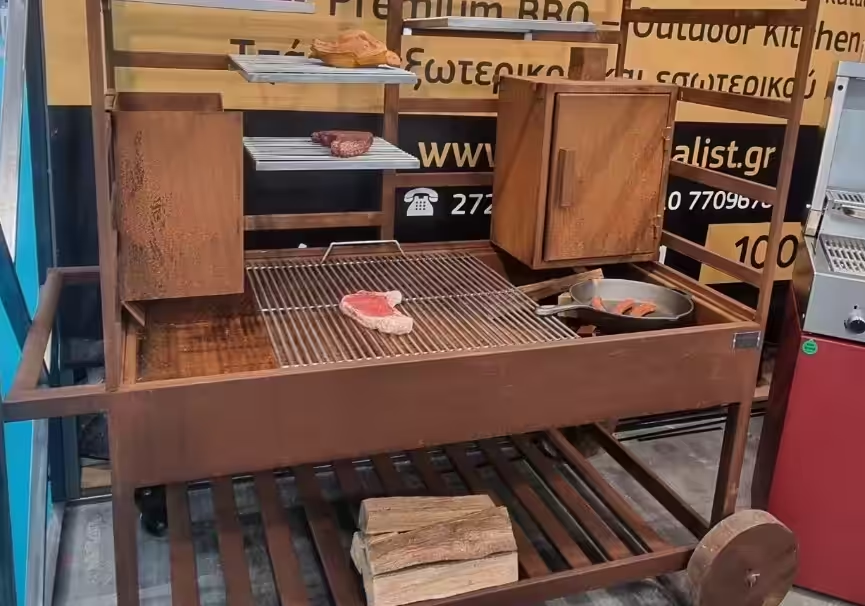
Five charcoal cooking techniques for the professional kitchen
Robata: the station that operates continuously, right in front of the customer
The robata is a Japanese technique featuring a long, low grill where food is cooked just inches above the hot coals. Its operating principle is the continuous flow of small portions that are ready in seconds and served immediately.
Two factors make it an ideal tool for the professional kitchen. First, its length allows for zones of varying heat intensity on a single grill—the chef moves the food around rather than waiting for it to cook in one spot. Second, its low profile and clean lines make it perfect for an open kitchen, turning the grilling process into part of the customer experience.
Our range includes the Robata Grill Roaster as a ready-to-use solution, the Robata Grill – 2-Level Spit-Roast Grill for when you need two heat intensities simultaneously, and the Corten Steel Robata Cart with Wood-Fired Smoker for outdoor spaces and events.
Suitable for: fusion and Asian cuisines, high-volume meze restaurants, hotel open kitchens, and wine bars serving small plates.
Parilla: distance-based control for large cuts
The parilla is based on a simple concept with immense practical value: the griller adjusts the temperature by raising or lowering the grate, rather than manipulating the fire itself. The wheel allows for centimeter-level precision—a game-changer for thick cuts that require slow, even cooking and a rich crust.
In practice, this is the technique that defines a steakhouse. Slanted grates with a grease collector channel fat away from the coals, minimizing flare-ups and preserving a clean flavor.
Available options: Parrilla Grill Roaster, the tabletop version for limited space, and the Biokan Roaster Parilla GP95 for heavy-duty use. When the menu calls for both, the custom-built Parilla–Robata unit combines both concepts into a single appliance.
Suitable for: steakhouses, meat-focused restaurants, and hotel à la carte venues that prioritize high-quality ingredients.
Charcoal grill
The charcoal grill is the most misunderstood piece of equipment in the lineup because it appears simple. In reality, it offers the highest productivity per linear meter of counter space, which is why it sits at the heart of every grill house.
The choice here is primarily a matter of length. The BIOKAN series ranges from 80 cm to 200 cm—spanning from the 120 cm CGS4 model for medium-sized kitchens to the 200 cm CGS7 designed for high, continuous throughput. While the entire series falls under the charcoal grill category, the broader grill category also includes gas or electric water-bath models for operations with exhaust system limitations.
Suitable for: grill houses, souvlaki shops, tavernas, and catering services with fixed menus.
Antikristo: scheduled production and a spectacle
The *antikristo* method involves arranging the meat vertically around the embers and roasting it via radiant heat, without direct contact with the flames. It is a tool for scheduled production: you set it up in the morning, serve it at midday, and the result is one of the few offerings that truly justifies premium pricing.
Three factors determine its success: the geometry of the pit and the airflow, the angle of the spits, and the mechanism’s ability to handle cuts weighing 15–25 kg. The catalog includes the *antikristo* grill with a charcoal tray, the professional GIGAS *antikristo* and standard grill for dual use, and the charcoal lamb grill with *antikristo* capability.
Suitable for: taverns and grill houses with busy weekends, event venues, and restaurants featuring live cooking.

Kontosouvli Grill: automation where volume counts
The kontosouvli grill solves the issue of scale. Multiple spits rotate automatically; the chef supervises rather than manually turning them, and productivity rises without a corresponding increase in staff.
Scaling up is straightforward: choose from countertop models with 3, 6, or 9 spits, or floor-standing units with a cabinet—such as the BIOKAN LGH94 with 9 spits, a cabinet, and an integrated hood. View the full range of professional charcoal grills, custom-built *kontosouvli* rotisseries, and machines for *kontosouvli*—including the SERGAS SGK9 charcoal model—along with corresponding electric and gas versions for venues where charcoal is not an option.
Suitable for: Grill houses specializing in *kontosouvli* and *kokoretsi*, butcher shops offering ready-to-eat meals, catering services, and mass food service operations.
A note on the enclosed charcoal oven
There is also a sixth category that is frequently asked about: the enclosed charcoal oven, often known by the brand that popularized it. It operates as a chamber with a door, thereby retaining heat, reducing fuel consumption per portion, and limiting smoke in the surrounding area. The trade-off is flexibility: the griller loses direct contact with the embers and the ability to adjust heat by varying distance—features offered by the parrilla and robata.
The closest equivalent in our product line is our enclosed units with a built-in smoker, such as the Corten wagon. If this specific approach interests you, it is worth discussing during the design phase.
Decision Matrix
| Technique | Portion size | Serving pace | Temperature control | Grill operator requirement | Space |
|---|---|---|---|---|---|
| Robata | Small (80–200 g) | Continuous, immediate | Zones along the length | High — dedicated operator | Long, narrow counter |
| Parrilla | Large (300 g – 1.5 kg) | Moderate, time-intensive | Precise, via height adjustment | High — expertise in meat cuts | Moderate, requires vertical clearance |
| Griddle/Grill | Small to medium | High, high-volume | Longitudinal zones | Medium | Linear, 80–200 cm |
| Antikristo | Very large (10–25 kg) | Planned | Via angle and distance | Medium, with supervision | Large, with height |
| Kontosouvli rotisserie | Medium, in a row | High, fixed | Via height relative to the heat source | Low — automation | Compact, 60–160 cm |
Most kitchens end up using a combination of two techniques: one for volume and one for the signature dish. This is also the most common reason why a custom-built unit works out more cost-effectively than two separate machines: one housing, one exhaust system, one counter.
Dimensions: length and number of spits required
The rule of thumb we use in our designs is based on peak demand, not the average.
For grills: calculate how many portions need to be on the grate simultaneously during the busiest part of the evening, and add extra space for a “holding zone”—the section of the surface that keeps cooked food ready without drying it out. Without this zone, the grill operator is forced to cook strictly according to the pace of incoming orders, and quality suffers right when it matters most.
For *kontosouvli* rotisseries: the number of spits determines the cooking cycle. Three spits handle steady, moderate demand. Six provide the necessary capacity for weekends. Nine units make sense when *kontosouvli* is a main menu item rather than just a side dish.
For parilla and robata: here, the usable depth is critical, not just the length. A depth that does not allow for a second row limits productivity, regardless of the size of the unit.
A common mistake when preparing proposals is basing the choice solely on available space. Space is a constraint; peak demand is the requirement. When the two conflict, the solution usually lies in the layout—and that is where custom fabrication comes in.
Extraction: the hood determines whether the kitchen works
This is where most installations fail. The grill is purchased correctly, yet the kitchen ends up filled with smoke.
Two main types cover almost all scenarios:
- Extraction hood: removes smoke and grease. It is the classic solution when the space is supplied with fresh air from an external source.
- Dual-function hood: combines extraction with fresh air supply. We choose this for enclosed kitchens, where extraction without make-up air creates negative pressure—causing doors to stick, air gaps to whistle, and extraction efficiency to drop.
There are also wall-mounted and island versions, depending on whether the grill is placed against a wall or stands freely in the center. The entire range can be found in the ventilation hoods category — with dimensions ranging from 150 to 396 cm to match the length of the grill.
Three things are worth considering from the very beginning:
- The hood dimensions are calculated in conjunction with the grill, not afterwards. Its width must cover the grilling area with some margin to spare; otherwise, smoke will escape from the sides.
- The air duct’s path matters just as much as the fan. Numerous bends and excessive length reduce actual performance.
- Cleaning is scheduled. Filters and internal surfaces trap grease—meaning it is a matter of fire safety, not just hygiene. Our services include equipment cleaning and refurbishment.
Some models address this issue with an integrated design: the BIOKAN series of floor-standing charcoal grills with a cabinet base is also available with an integrated hood, simplifying both installation and inspection.
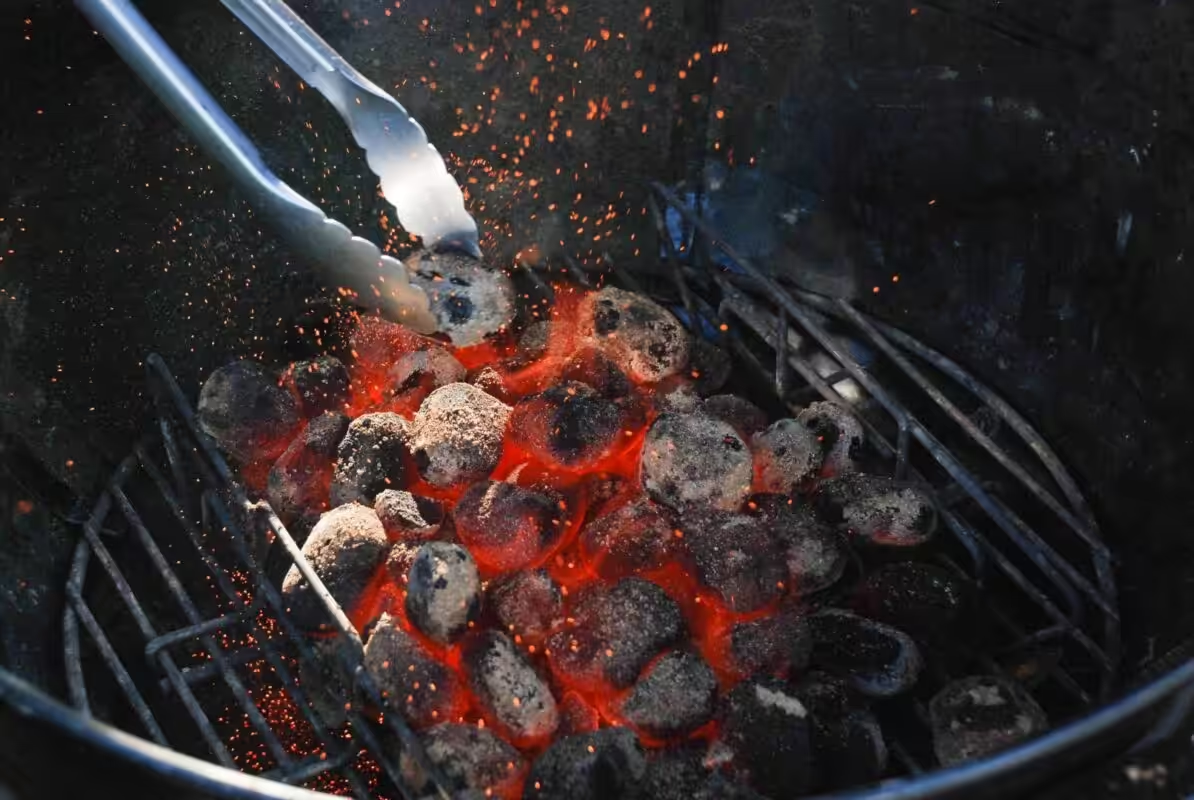
Charcoal: what you burn and what it really costs you
Consumption depends on more than just the appliance itself. It depends equally on the fuel.
Lump charcoal ignites quickly and produces high initial heat, but it burns unevenly and requires frequent replenishing. It is the ideal choice for quick grilling sessions and smaller portions.
Briquettes burn more steadily and for a longer duration. During a four- or five-hour session, this consistency means less intervention from the griller and more predictable results—such as with organic olive briquettes (10 kg), which utilize an olive oil production by-product. The full range can be found in the charcoal category.
Binchotan and similar hard charcoals burn very cleanly, producing intense radiant heat and minimal smoke. It is the traditional choice for robata, with a higher cost per kilogram but a longer burn time.
Two practical observations from installations: storage requires a dry area near the service line, as damp charcoal increases ignition time and consumption; and monitoring is worth the effort—a thermometer in the grilling zone costs very little and prevents over-consumption driven by mere guesswork.
Materials and construction: what lasts beyond the third year
In professional use, the difference between a good machine and a mediocre one becomes apparent in the third year, not at the time of delivery.
Heavy-duty 304 stainless steel at points of contact with food and heat. Thinner sheets warp during heating and cooling cycles, and this deformation causes grease to leak into hard-to-clean areas.
Sloped grease collector with a removable container. Grease dripping onto the coals causes flare-ups and a burnt taste; proper design channels it away before it reaches the heat source.
Heavy-duty motor for rotating mechanisms, capable of continuous operation for 8–12 hours. This is the component that fails first in cheaper models, usually within the very first peak season.
Corten steel for permanent outdoor installations, where surface oxidation acts as a protective layer while also providing a distinctive aesthetic.
Additionally, stainless steel structures and auxiliary components—such as work counters, cabinets, and shelves—define the workflow around the grill. An excellent grill paired with an unsuitable counter will underperform compared to a mediocre grill in a well-designed setup.
Ready-made model or custom build?
A ready-made model is the right choice when the available space accommodates it, delivery time is a priority, and the requirement can be met by a standard product range. It also offers the advantage of readily available spare parts.
A custom build is the ideal solution when at least one of the following applies:
- The space has unique characteristics that no standard dimensions can accommodate.
- The menu requires two cooking techniques in a single unit — e.g., parilla and robata, or standard grill and open-fire spit roasting.
- The exhaust system needs to be integrated into an existing installation.
- The kitchen is open to the public, and aesthetics matter just as much as functionality.
Usage is intensive, and the equipment must be designed for a specific workflow.
In the custom fabrications category, you will see examples of both approaches implemented, while the professional catering equipment section covers the rest of the kitchen equipment—from refrigerators and ovens to work counters and dishwashers. If you are planning an entire kitchen from scratch, the professional equipment buying guide covers the big picture.
Frequently Asked Questions
How much space do I need for a professional charcoal grill?
Beyond the machine’s dimensions, factor in a workspace at the front for the chef, space for the charcoal, and access for cleaning from the rear or sides. Charcoal grills start at 80 cm in length, so even compact kitchens have a solution.
Can I install a charcoal grill without an exhaust hood?
An exhaust system is a prerequisite for operation, not an optional accessory. Where exhaust installation isn’t feasible, the alternative is a gas or electric water-bath grill, which drastically reduces smoke.
How does a *parrilla* differ from a standard grill?
The lifting mechanism. With a *parrilla*, you adjust the heat intensity by moving the grate relative to the embers, whereas with a standard grill, you manage the fire itself. This difference is crucial for thick cuts of meat.
How often does charcoal equipment require maintenance?
Daily cleaning of grates and grease trays, weekly inspection of exhaust filters, and an annual full cleaning of the exhaust system. Rotation mechanisms require lubrication as specified by the manufacturer.
Which type of charcoal is more cost-effective for long-term use?
The cost per portion, rather than per kilogram, provides the answer. Briquettes usually cost more per kilogram but burn longer at a more stable temperature, making them often cheaper for extended service periods.
How long does a custom build take?
It depends on complexity and workload. The process begins with a site survey, design, and quotation—and the timeline is agreed upon before the order is placed.
Let’s design your line
Every professional installation begins with a discussion about the menu, the workflow, and the space. Send us your kitchen dimensions and a copy of your menu, and we will recommend the layout that maximizes portion output based on your available staff.
Visit our showroom to see Robata grills, Parrillas, standard grills, and Kontosouvli rotisseries in action, or contact us for a consultation and quote.